Thursday, August 26, 2010

Heavy Hindu Metal!


Most old timers will remember before Shelter there was this bunch of tattooed hoolies who embraced the peaceful meditations of the Hare Krishna sect. Didnae seem to stop them from making an almighty racket though.

Part of the crossover punk/thrash movement of the late 80s alongside bands such as DRI & Agnostic Front, Cro-Mags existed beyond that of mere novelty. Lyrics inspired by the holy books & thick crunching guitars saw them gain quite a following. Though their careers were short-lived, this LP still sounds fresh today & will inspire many lively dandruff removal sessions!

This album is testament that violent-sounding music need not cause ye to lead a violent life. Enjoy!

To download, Cromag's Best Wishes (1989), please click here: http://www.mediafire.com/?9uwlajahblg

Monday, August 23, 2010

Little Boys' Toys

Saw this in a back-dated issue of Octane mag & is a three-gear, pedal-powered junior sports car fer three-six year olds, produced by Morgan, UK, as part of their centenary celebrations last year.

And although me Master Seth is still a few months shy of his first birthday bash, me will have to start saving now if me wants to get him this. Why? Price fer this lil toy . . . a cool three thousand quid!!!


Donations to the 'Master Seth's Morgan Project' are welcome. Cheques accepted.

ps: Wifey has niggling suspicion that above three wheeler is fer me benefit, not Seth's. Me reassures her that me doubts the cockpit will be able to fit me ample frame . . .

Monday, August 16, 2010

The season is well &truly upon us!

Caption: A young Kopite is dejected after Pepe's blunder . . .

Ah well, despite a near disastrous outing with the MyRawk dudes (not their fault but fooking Astro's!!!), me was sufficiently pleased with the outcome of our season opener.

Great thing about the start of every football season is that it brings a sliver of opitmism to all concerned, even to hardened cynics like meself. Let season roll on!

Sunday, August 1, 2010

Not-so-fast & Furious!

Despite having been interested in cars fer a long time, me has never been active in any motoring club. But this morning, wifey & meself made the effort to roll out of bed fer our maiden Ulu Yam run. Don't know why, but the Italian bug has bitten hard & has certainly given a fresh twist to weekend activities (goodbye lingering hangovers, hello teetotal morning drives!).

Bout 20 other enthusiasts (or lunatics depending on yer standpoint) gathered at Batu Caves fer the flag off & we were soon to experience yet another glorious chapter in this so-called midlife crisis of mine. The twisty, bendy B-roads leading to Ulu Yam certainly makes fer challenging driving & with most of these guys seasoned veterans of the route & having fooking throttle-heavy feet, it was quite the adventure especially fer novice (& conservative) drivers like meself!
But hey, as the participants were keen to stress, biar mati eksyen, jangan mati accident. Safety first & we was repeatedly reminded to enjoy ourselves & to drive at our own pace. Easier said than done when most of the cars start zipping past ye & disappearing off into the horizon!
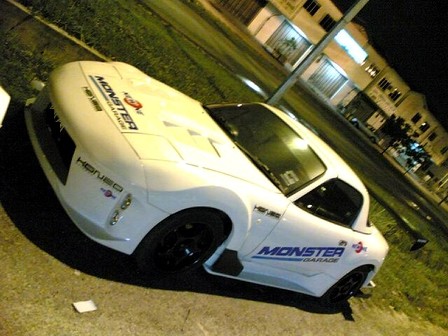
Pix above demonstrate the quirky demands of our beloved rides as most took the scheduled breaks to give the engines a little breather. Don't really think ye sees the Porche/Beemer/insert-appropriate-reliable-marque having fag breaks with their fooking hoods up! But therein lies the charm of these wonderfully idiosyncratic machines. Unreliable they may be & even expensive to maintain, there's something bout them Italian breeds that just makes us obsessive (think Cameron Diaz in Something About Mary & ye gets the picture).

Me has longed heard of Italian car owners waxing lyrical about their rides despite spending most of their time in garages & have often wondered wot is it bout these cars that engendered such fervent passion & pride. This trip has made it even clearer. Despite the mystery "sounds" that emanate from various crevices, the dodgy temp gauge ("how hot was yer car?" was an oft-asked question during the run) & being at the arse end of the contingent, me still emerged feeling exhilarated, thrilled & pleased-as-Willie-fooking-Wonka-in-the-choc-factory.

Fun, camaraderie & the simple pleasure of taking yer ride out on some nice winding route. Fooking brilliant!

Tuesday, July 27, 2010

Counting me blessings


Life is good . . . & me is a lucky fooker.

Friday, July 23, 2010

Get Shirty

Ye've got to hand it to them, these ruling coalition muthafookers. They truly are master manipulators & sly-as-fooking-fox shit-stirrers.

In case ye haven't heard, some half-arsed cleric has stoked the fires by calling fer a ban on certain football jerseys. And quite knowingly decided to stir the hornet's nest by singling out the glory hunter factory that is man yew. (http://news.malaysia.msn.com/weird-news/article.aspx?cp-documentid=4232887)

And typically responding by accussing said cleric as a Kopite, these effing khants conveniently forget the REAL issue at hand.

HARGA PETROL NAIK LAGI LA BODOH!!!!

Sunday, July 18, 2010

Boys & Their Toys

Being a new dad pretty much means me is cooped at home most weekends. So last Saturday night me decided it was good time to try out me new toy - a Black & Decker orbital polisher.

Started the wash at 10pm & since this was me debut effort with the machine, it took longer than the usual bicep-powered method. Careful not to scratch the surface, me managed to finally finish the polishing & waxing at the ungodly hour of 3am! (Neighbour thought me was fooking nuts).

But this was the result . . .


Not bad fer a first time if me says so meself . . .


Feeling quite pleased with the effort, there was enough time fer a "small" reward just before the crack of dawn.

ps: Of course, following tradition, if ye wash yer car, it will rain. And since me washed, polished & waxed the car, it fooking pissed down with rain the ENTIRE fooking Sunday . . . Ah well, good excuse to crack open a few more beers next weekend . . .

Thursday, July 15, 2010

The Numbers Game


This an interesting article from the Guardian. Do take the time to read & share yer thoughts on this. After all, most of us think we can do a better job than (*insert appropriate name of manager/coach here*) . . .

The Question: What next for 4-4-2?
British football's favourite formation isn't dead – but the World Cup proved the future of 4-4-2 looks bleak


Is 4-4-2 set to become a thing of the past? Photograph: JA Hampton/Getty Images
This was a bad World Cup for a lot of old favourites – anybody who appeared on the Nike ad, Marcello Lippi, preconceptions about Africa – but none of them had quite such a miserable tournament as 4-4-2. When even its old friend Michael Owen starts doubting it, the future for the formation that has ruled British football for 40 years looks bleak.

Johan Cruyff got stuck in as well last week – not particularly surprisingly given his lifelong ideological insistence on 4-3-3 – pointing out that "the numbers don't match up" and explaining that a system of three straight bands doesn't lend itself to the creation of passing triangles. This has always been an axiom: all else being equal, a triangle will always beat a line, and the Cruyff mode of play has always been predicated on the creation of triangles. A 4-2-3-1, with its W shape in midfield, is essentially comprised of interlocking triangles.

Which raises the question of why, if 4-4-2's disadvantages are so obvious, it has survived for so long? To start with, it should be made clear that Cruyff is speaking about his particular vision of football, which is rooted in ball possession and pressing, something that caused him, even before the game, to align himself with Spain rather than Holland in the World Cup final. That is one way to play – and the recent success of Barcelona and Spain shows it is a successful way to play – but it certainly isn't the only way. That a short-passing, technique-based game isn't for everybody was demonstrated very clearly in a tournament in which many people preferred the more dynamic, if more reactive, football of Germany.

Those passing triangles are only important for a side looking to dominate possession. For a side looking to disrupt that, 4-4-2 can be extremely effective – the famous "two banks of four" that for a long time seemed to be such a feature of any English team playing an away game in European competition. Fulham showed last season how effective the style can still be. Sit the midfield line deep on the back four so there is minimal space between the lines for attacking midfielders or deep-lying forwards to exploit, and it becomes very hard to penetrate. It doesn't matter how many triangles you create if you never get the ball closer than 35 yards from the opposition goal.

Think of Gérard Houllier's Liverpool away to Roma in the Uefa Cup in 2001, with Owen and Robbie Fowler left high upfield, often 50 yards and more from the midfield: keep it tight, make sure of the clean sheet, and if, as in that case, Owen can pilfer two goals, that's a bonus. Think of Fulham in the Europa League semi-final against Hamburg.

Slovenia's method both in qualifying and at this World Cup, although slightly more possession-based, wasn't dissimilar, particularly after Zlatan Ljubijankic had replaced Zlatko Dedic. Ljubijankic is a more technical player and a better finisher than Dedic, but he doesn't drop off and doesn't forage which, at least against England – a game in which Slovenia played with such trepidation you wondered if anybody had told them Stan Mortensen and Tom Finney had retired – left Valter Birsa's occasional forays on the right as the only bridge between midfield and attack.

Sacchi's squeeze and the modern stretch
So 4-4-2 has a future as a reactive formation, yet it was also the preferred formation of Arrigo Sacchi, probably the most proactive coach of all. It was the system's defensive attributes, though, that made it work for him. The great strength of the Milan of the late 80s was its pressing, with Sacchi demanding an ideal of 25 metres from centre-forward to centre-back when his side were out of possession. They squeezed high up the pitch, and so 4-4-2 made sense because a four-man midfield meant each member of the back four was protected by a midfielder and so was less likely to be isolated (which, with acres of space behind him, was a real concern).
Possession was less of a concern for Sacchi. I recently watched Milan's 5-0 victory over Real Madrid in the second leg of the semi-final of the 1989 European Cup, and was struck by how often (comparatively speaking) they gave the ball away. Madrid, for long periods, looked the better side on the ball, but were undone by the dynamism of Sacchi's side (although 5-0 was still a freakish scoreline). It's probably the case that, as Egil Olsen posited in a more pragmatic context, a team have to choose between prioritising possession and position on the field.

Pressing is still part of the game, and Barcelona and Spain both perform the high press excellently, but it has been made harder to execute because of the liberalisation of the offside law. The effective playing area has been stretched, and as a result, three-band systems have increasingly been replaced by four-band systems.

Perhaps it is just about conceivable that, if players could be persuaded to put their egos to one side (and that could be an issue for Roy Hodgson if he attempts to apply the Fulham system at Liverpool this season), a club team could still be drilled into an effective pressing 4-4-2, but achieving that level of discipline is an exhausting, demoralisingly boring process that became too much even for Milan after three seasons; it was very hard to implement then, with the change in the offside law and players enjoying greater freedom to change clubs it is even harder now. At international level, anyway, where the time available to work with players is limited and they are fatigued by club commitments, it is impossible, something even Sacchi was forced to acknowledge.

4-4-2 isn't dead
What the World Cup has done is to expose the problems 4-4-2 without hard pressing faces, and not just in terms of being outnumbered in midfield; with the stretching of the effective playing area, the midfield band can become exposed, with space in front of it and space behind it. That gap between defensive and midfield lines was precisely the space Mesut Ozil exploited so well in the first half of Germany's victory over England (this space, as Matthias Sindelar, Alfred Bickel, Laszlo Kubala, Nandor Hidegkuti, Pelé, Günter Netzer,Diego Maradona, Ruud Gullit, Zinedine Zidane, Rui Costa and Juan Román Riquelme and countless others have demonstrated, has always been a problem for England, and that weakness is one of the reasons Eric Cantona, Dennis Bergkamp and Gianfranco Zola were so successful in the Premier League in the 90s). Quite apart from the furious search for immediate justice that followed the non-award of a goal after Frank Lampard's shot had crossed the line, it may be that a desire to compress that area was partly behind England's suicidally high line in the second half of that game.

And yet when the Premier League begins again next month, probably around half the sides will be playing 4-4-2, and not all as a stifling tactic. That is not because of a lack of tactical sophistication, or at least not just because of a lack of tactical sophistication: 4-4-2, to those brought up in Britain, is the default; it's what every player is brought up to understand. A five-man midfield, however it is arrayed, brings its own problems, perhaps most obviously that it can be difficult, particularly for less technical teams, to get men forward to support the lone striker.
Below the very highest level, it may be that it is better simply to let players do what comes naturally.

Then there is the issue of personnel, particularly at clubs with a relatively limited budget. At Sunderland, for instance, Steve Bruce may like the idea of 4-2-3-1, but when he has Kenwyne Jones and Darren Bent forming a potent partnership, it makes little sense to disrupt it, even if the corollary is that he occasionally loses control of midfield. Sunderland's form last season notably improved when Steed Malbranque moved to the left and began cutting infield, effectively giving Sunderland an auxiliary central midfielder and bringing them greater control in the centre.

So 4-4-2 isn't dead, but the World Cup confirmed that the trend of the past decade at the highest level is against it.

Is 4-4-2 set to become a thing of the past? Photograph: JA Hampton/Getty Images
This was a bad World Cup for a lot of old favourites – anybody who appeared on the Nike ad, Marcello Lippi, preconceptions about Africa – but none of them had quite such a miserable tournament as 4-4-2. When even its old friend Michael Owen starts doubting it, the future for the formation that has ruled British football for 40 years looks bleak.
Johan Cruyff got stuck in as well last week – not particularly surprisingly given his lifelong ideological insistence on 4-3-3 – pointing out that "the numbers don't match up" and explaining that a system of three straight bands doesn't lend itself to the creation of passing triangles. This has always been an axiom: all else being equal, a triangle will always beat a line, and the Cruyff mode of play has always been predicated on the creation of triangles. A 4-2-3-1, with its W shape in midfield, is essentially comprised of interlocking triangles.

Which raises the question of why, if 4-4-2's disadvantages are so obvious, it has survived for so long? To start with, it should be made clear that Cruyff is speaking about his particular vision of football, which is rooted in ball possession and pressing, something that caused him, even before the game, to align himself with Spain rather than Holland in the World Cup final. That is one way to play – and the recent success of Barcelona and Spain shows it is a successful way to play – but it certainly isn't the only way. That a short-passing, technique-based game isn't for everybody was demonstrated very clearly in a tournament in which many people preferred the more dynamic, if more reactive, football of Germany.

Those passing triangles are only important for a side looking to dominate possession. For a side looking to disrupt that, 4-4-2 can be extremely effective – the famous "two banks of four" that for a long time seemed to be such a feature of any English team playing an away game in European competition. Fulham showed last season how effective the style can still be. Sit the midfield line deep on the back four so there is minimal space between the lines for attacking midfielders or deep-lying forwards to exploit, and it becomes very hard to penetrate. It doesn't matter how many triangles you create if you never get the ball closer than 35 yards from the opposition goal.

Think of Gérard Houllier's Liverpool away to Roma in the Uefa Cup in 2001, with Owen and Robbie Fowler left high upfield, often 50 yards and more from the midfield: keep it tight, make sure of the clean sheet, and if, as in that case, Owen can pilfer two goals, that's a bonus. Think of Fulham in the Europa League semi-final against Hamburg.

Slovenia's method both in qualifying and at this World Cup, although slightly more possession-based, wasn't dissimilar, particularly after Zlatan Ljubijankic had replaced Zlatko Dedic. Ljubijankic is a more technical player and a better finisher than Dedic, but he doesn't drop off and doesn't forage which, at least against England – a game in which Slovenia played with such trepidation you wondered if anybody had told them Stan Mortensen and Tom Finney had retired – left Valter Birsa's occasional forays on the right as the only bridge between midfield and attack.

Sacchi's squeeze and the modern stretch
So 4-4-2 has a future as a reactive formation, yet it was also the preferred formation of Arrigo Sacchi, probably the most proactive coach of all. It was the system's defensive attributes, though, that made it work for him. The great strength of the Milan of the late 80s was its pressing, with Sacchi demanding an ideal of 25 metres from centre-forward to centre-back when his side were out of possession. They squeezed high up the pitch, and so 4-4-2 made sense because a four-man midfield meant each member of the back four was protected by a midfielder and so was less likely to be isolated (which, with acres of space behind him, was a real concern).
Possession was less of a concern for Sacchi. I recently watched Milan's 5-0 victory over Real Madrid in the second leg of the semi-final of the 1989 European Cup, and was struck by how often (comparatively speaking) they gave the ball away. Madrid, for long periods, looked the better side on the ball, but were undone by the dynamism of Sacchi's side (although 5-0 was still a freakish scoreline). It's probably the case that, as Egil Olsen posited in a more pragmatic context, a team have to choose between prioritising possession and position on the field.
Pressing is still part of the game, and Barcelona and Spain both perform the high press excellently, but it has been made harder to execute because of the liberalisation of the offside law. The effective playing area has been stretched, and as a result, three-band systems have increasingly been replaced by four-band systems.

Perhaps it is just about conceivable that, if players could be persuaded to put their egos to one side (and that could be an issue for Roy Hodgson if he attempts to apply the Fulham system at Liverpool this season), a club team could still be drilled into an effective pressing 4-4-2, but achieving that level of discipline is an exhausting, demoralisingly boring process that became too much even for Milan after three seasons; it was very hard to implement then, with the change in the offside law and players enjoying greater freedom to change clubs it is even harder now. At international level, anyway, where the time available to work with players is limited and they are fatigued by club commitments, it is impossible, something even Sacchi was forced to acknowledge.

4-4-2 isn't dead
What the World Cup has done is to expose the problems 4-4-2 without hard pressing faces, and not just in terms of being outnumbered in midfield; with the stretching of the effective playing area, the midfield band can become exposed, with space in front of it and space behind it. That gap between defensive and midfield lines was precisely the space Mesut Ozil exploited so well in the first half of Germany's victory over England (this space, as Matthias Sindelar, Alfred Bickel, Laszlo Kubala, Nandor Hidegkuti, Pelé, Günter Netzer,Diego Maradona, Ruud Gullit, Zinedine Zidane, Rui Costa and Juan Román Riquelme and countless others have demonstrated, has always been a problem for England, and that weakness is one of the reasons Eric Cantona, Dennis Bergkamp and Gianfranco Zola were so successful in the Premier League in the 90s). Quite apart from the furious search for immediate justice that followed the non-award of a goal after Frank Lampard's shot had crossed the line, it may be that a desire to compress that area was partly behind England's suicidally high line in the second half of that game.

And yet when the Premier League begins again next month, probably around half the sides will be playing 4-4-2, and not all as a stifling tactic. That is not because of a lack of tactical sophistication, or at least not just because of a lack of tactical sophistication: 4-4-2, to those brought up in Britain, is the default; it's what every player is brought up to understand. A five-man midfield, however it is arrayed, brings its own problems, perhaps most obviously that it can be difficult, particularly for less technical teams, to get men forward to support the lone striker.


Below the very highest level, it may be that it is better simply to let players do what comes naturally. Then there is the issue of personnel, particularly at clubs with a relatively limited budget. At Sunderland, for instance, Steve Bruce may like the idea of 4-2-3-1, but when he has Kenwyne Jones and Darren Bent forming a potent partnership, it makes little sense to disrupt it, even if the corollary is that he occasionally loses control of midfield. Sunderland's form last season notably improved when Steed Malbranque moved to the left and began cutting infield, effectively giving Sunderland an auxiliary central midfielder and bringing them greater control in the centre.

So 4-4-2 isn't dead, but the World Cup confirmed that the trend of the past decade at the highest level is against it.

Tuesday, July 13, 2010

Smile when yer winning!

Well done laddie!
But us Kopites would appreciate a few nailed-on certainties besides this pix that yer staying & help us get out of the fooking pit that the Yanks have dugs us into.
Me cordially invites all of ye to speculate on the possible transfers (or lack thereof) to yer own teams.
Let the real footie begin . . .

Wednesday, July 7, 2010

When's the next flight to Ascuncion?


(Lifted from the online reports)
Introducing: Paraguay’s ‘biggest’ fan
Larissa Riquelme gives the thousands of heartbroken Paraguayan fans something to cheer about despite their national team’s exit from the World Cup.

It's a troubling time for Paraguayans across the globe. Up to 50% of its population lives in poverty. An ever worsening economic recession continues to devastate the nation's wealth. Job opportunities and household income carry on worsening with every waking moment. And more recently, its national football team suffered an exit from the 2010 World Cup by the hands of the Spanish.

However, amidst the prevalence of this madness, one loyal Paraguayan stands out amongst a crowd of chaos as a voice of reason. One woman, benevolent of her nation's happiness and well-being sets out to accomplish what her national football team could not, to lift her nation's spirits, even if it means 'taking it all off' in the most literal sense of the phrase.


Larissa Riquelme, 25 year-old lingerie model, made a promise to her nation's people, that she would match Diego Maradona's promise to run naked through the streets of Buenos Aires if Argentina had won the World Cup.

Instead, Larissa would do it in Asunción, the capital of Paraguay, at the cost of simply reaching the semi-finals. However, Paraguay failed to make it pass Spain and the hearts of the nation slumped into an abyss of devastation. But the benevolent Larissa would not let this be.

Larissa has said that she's still going to carry out her promise, despite the Paraguayan team's premature exit from the 2010 World Cup. Such is the dedication and compassion of one Larissa Riquelme, citizen of Paraguay, our hero.


FFS says: And yet some people say this edition of the Copa Mondial has been dull . . .

ps: Sour grape aunties in me dept say them globes are fooking fake . . .